
The Payam Method Just Made 60 Minutes
Fun over fear. Songs over standard notation. Simple practice methodologies. Sound familiar?
Why This Moment Matters
Most kids who start music lessons quit within 4 months. The reason is almost always the same: it stops being fun before it starts feeling rewarding. Traditional music education front-loads the hardest, least musical parts of the experience — reading notation, drilling scales, playing boring songs students can’t relate to — and then wonders why engagement craters.
We were so happy to see 60 Minutes dedicate a segment to a better way of music education. It’s a signal that the broader culture is ready to admit the old way wasn’t working. The Payam Method, built around number-based notation, song choice that matches student taste, and composition from day one, is getting a long-overdue spotlight. And the results — students winning national competitions, 12-year-olds writing their third original composition — prove this isn’t soft pedagogy. It’s better pedagogy.
At Moosiko, we’ve been making the same argument for all modern band instruments: guitar, ukulele, and piano. Here’s what we share, and where we’ve taken it even further.
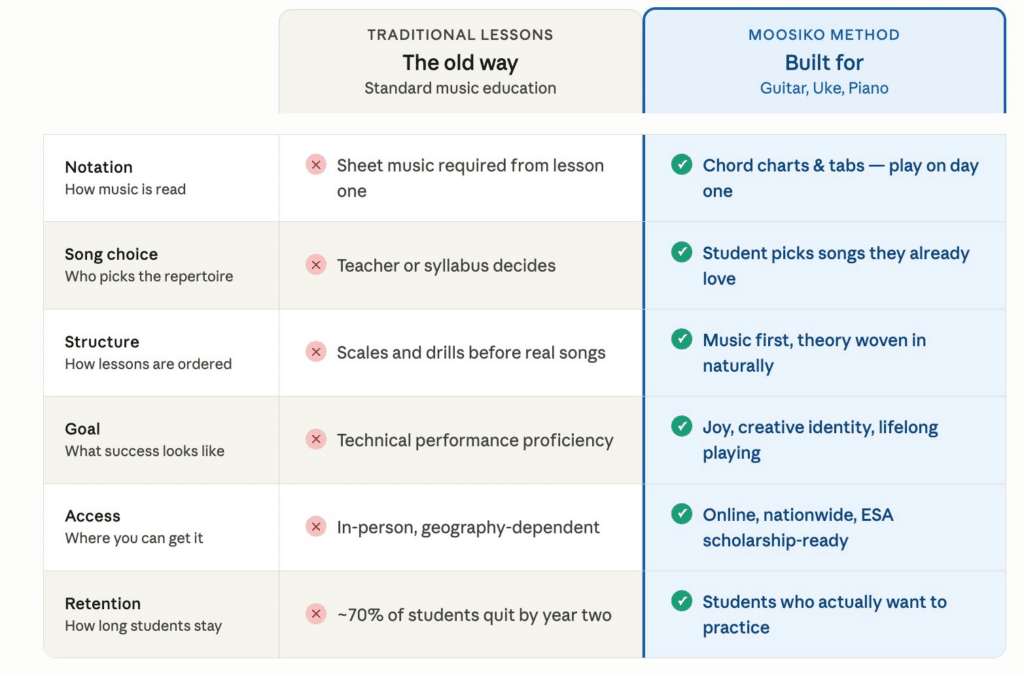
The Moosiko Method vs. Traditional Music Lessons
The parallels between what Payam built for piano and the Moosiko Method we built for guitar, ukulele, and piano are striking — because they come from the same diagnosis of why music education fails kids. Get 3 lessons free and check it out for yourself.
What We Share with the Payam Method
Simplified visuals first, standard notation and theory later
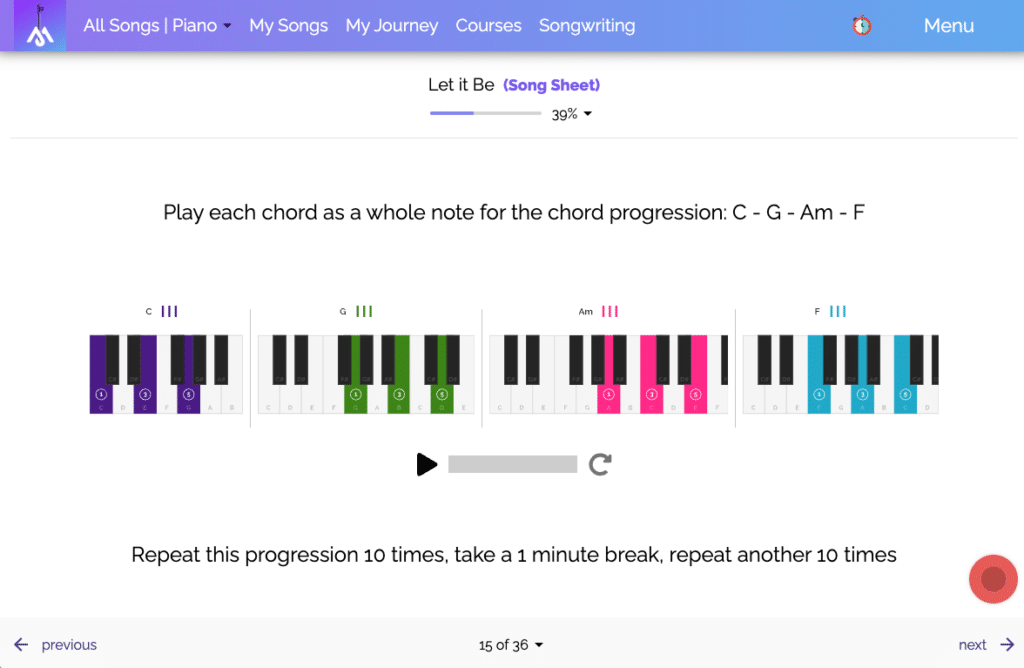
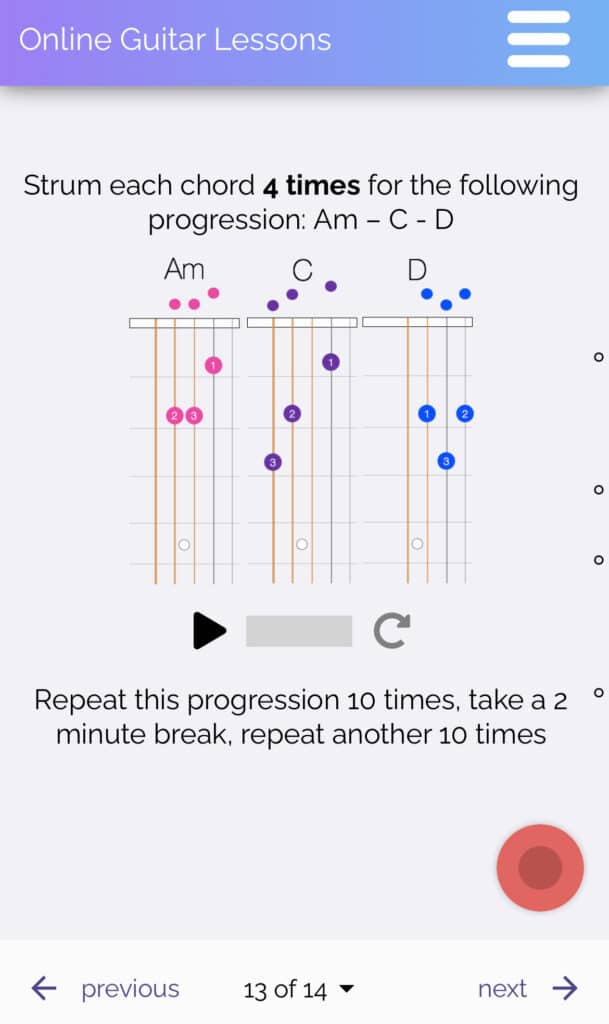
The Payam Method starts students on numbers instead of sheet music. The insight is the same one that underlies Moosiko’s visual-first approach: if you make someone decode a new language before they’ve made a single satisfying sound, you’ve lost them. A student can pick up a guitar or piano on day one, look at a Moosiko lesson, and play a recognizable chord progression from a song they know. That feeling — “I’m actually playing music” — is the hook. Standard notation can come later, once the student can play the instrument.
Song choice follows the student, not the curriculum
One of the most consistent findings in music education research is that student-directed repertoire dramatically improves motivation and retention. Payam’s students play songs they love. Moosiko has built a library of over 400 songs across genres (indie rock, pop, country, K-pop, classic rock, singer-songwriter) and languages (English, Spanish, Japanese, Korean) — and our teachers match songs to the individual student. A student into Radiohead gets different material than a student into Taylor Swift. Both get equally rigorous musical development. Neither gets handed a book of classical exercises and told to trust the process.
Skill Tracking & Games
Payam described his lessons to 60 Minutes as playing a game. Moosiko’s platform is built around the same psychology — progress that’s visible, goals that are reachable in a single session, and skill-building that feels like play rather than homework. When practice is intrinsically rewarding, students practice more. We specifically show students’ skills and practice time to keep them motivated.

Music Theory Built From Curiosity
After learning their 6th Taylor Swift song, students often ask, “Why are all the chords the same?”. We love this because students naturally get curious about music theory without having to force it. When a Moosiko student learns that every song in a given key uses the same small family of chords, they’re learning the I-IV-V relationship. Then we start to talk about more advanced topics such as keys, transposition, and major/minor, and musicology. Theory is embedded in the musical experience rather than isolated as a prerequisite.
Audio Files
Here are the main reasons why parents choose Moosiko Online Music school for guitar, ukulele, and piano:
- Built for schools and homeschoolers: Used in 300 school districts teaching 25k students in grades 3 – 12
- Multi-Instrument: We teach guitar, ukulele, piano, and songwriting. We find students like to explore.
- ESA approved: Structured, certified curriculum that meets educational credentials across the homeschool requirements.
If you’d like to see our methods in action, click here to try 3 lessons for free.