
Music lessons are one of the highest-leverage additions a microschool can make to its program to boost enrollment and keep parents and students enriched and engaged. It’s a top-three request from prospective parents during enrollment tours, it’s an ESA/school-choice-eligible tuition item in most states (instruments, curriculum, and instruction all typically qualify), and, unlike a science lab or a sports program, it can be stood up in a single classroom with a handful of instruments and an internet connection.
How to add music to your curriculum can be a bit tricky. Microschool founders typically land on one of three models: teach it themselves, purchase a packaged virtual music program, or bring in an in-person music teacher. Each has trade-offs in cost, founder time/expertise, and instructional quality. We explore the differences in all three options below. We used the following assumptions as a representative microschool enrollment in all three examples:
- 10 students (5 learning guitar, 3 learning ukulele, 2 learning piano)
- Instruments: 5 full-size guitars, 3 soprano ukuleles, 2 digital keyboards
- Live virtual lessons: $120/hr, no travel or setup time
- Live in-person lessons: $70/hr. Billed at $140/session due to a total of 2 hours for travel and setup time
tldr quick answer: Once instruments are purchased, ongoing costs run about $200 – $500 per student, per year, depending on the model. The cheapest option is the founder-led DIY program which wouldn’t cost anything, the priciest option is weekly in-person music lessons, and the virtual option sits in the middle.
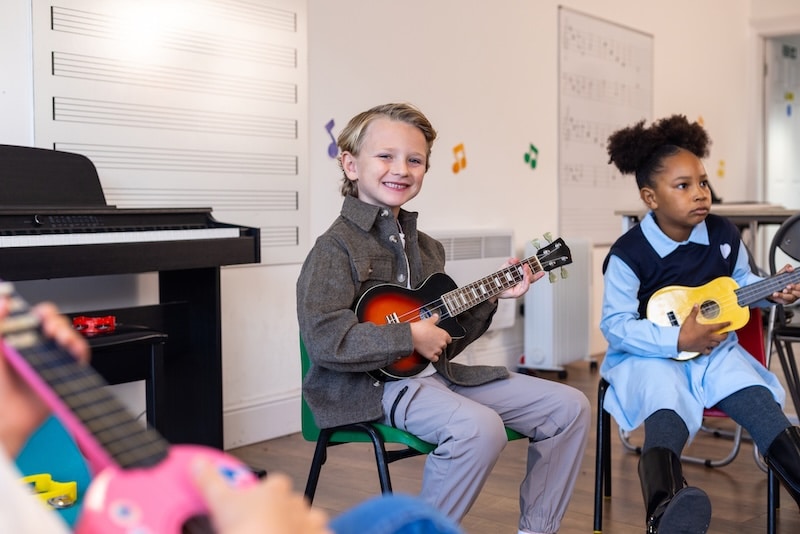
Microschool music lessons can enrich your curriculum with fun, brain-building activities that both parents and students value
At-a-Glance Comparison
| 1. DIY (Founder-Led) | 2. Virtual (Platform + Biweekly Live) | 3. In-Person (Weekly visits) | |
|---|---|---|---|
| Who teaches | You (or existing staff) | Self-paced platform + certified instructor via video | Contracted/employed music teacher on-site |
| Lesson cadence | Self-directed, founder sets pace | Biweekly live group sessions + self-paced platform | Weekly in-person group sessions |
| Founder time required | High (ongoing every week) | Low (scheduling + student account setup) | Low (scheduling + oversight only) |
| Instructional consistency | Variable – depends on founder’s music background | High – professional curriculum + asynch teacher feedback + certified instructor | High – professional instructor, real-time feedback |
| Year 1 total cost | $2,195 | $6,345 | $7,235 |
| Ongoing Yearly Cost | $0/yr (just founder time) | $4,150/yr | $5,040/yr |
| Per Student Cost | $0/yr | $415/yr | $504/yr |
| Best for | Bootstrapped schools, founder is musically competent | Schools wanting a convenient, flexible, and customized program while maintaining instructional quality | Schools able to hire local, expert music teachers |
Year 1 total includes the one-time $2,195 instrument purchases.
Before You Choose: 4 Factors That Should Drive the Decision
Most founders default to whichever option feels most familiar, but the right call actually hinges on four things:
- Do you know how to play and teach music – including guitar, piano, ukulele, singing, songwriting, and theory? This determines whether DIY is even viable. Students have a diverse range of musical interests, instruments, and skill sets (especially for enrollments with a wide age range). If you don’t have a musical background to support that diversity of musical instruction, DIY is probably not the right option.
- Your own bandwidth, honestly assessed. DIY only works if you can protect 2–4 hours/week indefinitely. If music is the first thing that gets cut when enrollment season hits, it will show up in program quality.
- What you’re marketing to prospective families. “Certified music instruction” on an enrollment flyer converts differently than “founder-led.” If music is a recruiting differentiator for your school, that changes the ROI math on the pricier options. Most microschools pass music program costs onto parents via a dedicated “music” or “enrichment” line item. Parents are happy to pay it.
- ESA funding & tuition payment. If your state’s ESA program reimburses curriculum and instruction as separate line items (common with programs like ClassWallet and Odyssey), a platform-plus-instructor model can sometimes be fully funded even when a pure staffing model isn’t – worth checking before you rule out Option 2 or 3 on cost alone. And parents that are paying your tuition using their ESA funds can absorb another few hundred dollars for the added benefit of music enrichment.
Option 1: DIY – Founder-Led Music Program
The founder (or existing staff member) delivers music instruction directly, typically using a selected curriculum so you’re not creating lesson plans from scratch.
Strengths:
- Lowest cash option – no instructor fees
- Full schedule control; lessons happen whenever fits the school day
- Tightest feedback loop between music and the rest of your curriculum (you can tie a song into a history or math lesson the same week)
- No dependency on a third party’s availability, cancellations, or pricing changes
Weaknesses:
- Instructional quality limited by the founder’s own musical competence. Most founders are not trained music educators
- Real opportunity cost: every hour teaching music is an hour not spent on operations, admissions, or other curriculum
- Harder to market as a “program” to prospective parents vs. “we have a credentialed music teacher”
- No built-in scalability: doubling enrollment roughly doubles your personal teaching load
- Risk of program quality declining or lapsing entirely during busy periods (enrollment season, year-end)
Estimated Cost for DIY
| Item | Detail | Cost |
|---|---|---|
| Instruments | 5 guitars, 3 uke, 2 piano | $2,195 (one-time) |
| Live instructor fees | None | $0 |
| Year 1 Cost | $2,195 | |
| Ongoing Yearly Cost | $ few hundred* | |
| Per Student Cost | $ nearly 0 |
This is the cheapest path by a factor of nearly 2x, but the “cost” that doesn’t show up in this table is your own time. If you value your hours at even $40/hr and DIY teaching eats 3 hours/week across a 36-week year, that’s an additional ~$4,320 in opportunity cost — which puts DIY roughly on par with the virtual option once you price in your own labor honestly.
*Additional costs would likely be small consumables such as strings, stands, printed music, and curriculum. Unless you’re building lesson plans and content entirely yourself.
Option 2: Virtual Program – Self-Paced Platform + Curriculum + Biweekly Live Lessons
A structured self-paced learning platform (video lessons, curriculum, progress tracking) supplemented by live group lessons. This is the “hybrid-lite” model that’s gained traction with microschools specifically because it provides a convenient and flexible out-of-the-box option across all instruments, ages, and cost.

Self-paced learning platform helps students practice at their own pace
Strengths:
- Certified music instruction without hiring or scheduling an on-site employee
- Self-paced platform lets students go at their own pace. Built-in video tools allow for teacher feedback & support between live lessons
- Live group sessions provide structured foundational content + real-time feedback for students
- Best for shy students who can go at their own pace and won’t feel like “eyes are on them”
- Super convenient: Online lessons makes it easy to match teacher availability with microschool schedules. Easier to scale to growing enrollment and new instruments
- Typically the easiest model to bundle into ESA-eligible line items (music curriculum, enrichment fee…etc.)
- No geographic constraint on instructor quality, you’re not limited to who’s available to drive to your campus
Weaknesses:
- Virtual instruction provides less opportunity for dedicated 1:1 time
- Dependent on decent internet and webcam setup at your school; tech hiccups eat into lesson time
- Group video lessons are harder to manage for younger or easily-distracted students than in-person
- Harder to have that “teacher connection” for virtual lessons compared to an in-person instructor
Since virtual programs are highly flexible and customizable, costs are dependent on live instructor frequency. If you want monthly lessons, the price drops by about $1k. If you want separate lessons for guitar and piano, the live instructor fees would add $1k. One of the benefits of this option is the ability to create a custom program that fits your cost, schedule, and student/parent music needs.
Estimated Cost for Virtual Programs
| Item | Detail | Cost |
|---|---|---|
| Instruments | 5 guitars, 3 uke, 2 piano | $2,195 (one-time) |
| Learning platform licenses | 10 students @ $199/yr | $1,990/yr |
| Live instructor fees | 18 biweekly sessions × 1 hr × $120/hr | $2,160/yr |
| Year 1 Cost | $6,345 | |
| Ongoing Yearly Cost | $4,150/yr | |
| Per Student Cost | $415/yr |
A note on this model: this is essentially the structure Moosiko Online Music School is built around: self-paced curriculum (guitar, ukulele, piano, songwriting), live group instruction at a frequency that meets your needs, video tools for asynch teacher feedback, and discounted instrument options. Moosiko is an approved ESA vendor across roughly 26 states via ClassWallet and Odyssey. If Option 2 is the direction you’re leaning, it’s worth a look before stitching together a curriculum vendor and a separate instructor on your own — see Moosiko’s microschool program →.

Built-in video tools allow teachers to provide individualized feedback and tips to students between lessons
Option 3: In-Person Teacher – Weekly On-Site Lessons
A contracted or part-time music teacher comes on-site weekly to deliver group lessons in person.
Strengths:
- Highest-touch instruction. More 1:1 student attention and correction that’s hard to replicate over video
- Strongest marketing asset: “in-person music instructor” reads as a premium, fully-staffed program to prospective families
- Instructor becomes a known, trusted face in your school community. Often extends into recitals, performances, or cross-curricular collaboration (comes as added cost)
- No dependency on tech/internet reliability during lesson time
Weaknesses:
- By far the most expensive option, both per-session and annually
- Founder/school bears scheduling risk. Sick days, no-shows, and instructor turnover directly disrupt the program
- No self-paced, asynch practice platform support so students are only learning and practicing the 1 hour/week during lessons
- Geographic constraint: you’re limited to instructors willing/able to travel to your campus, which can mean fewer options in rural areas
- Least scalable: growth requires either larger group sizes (diluting instruction quality) or hiring additional instructor hours, especially if an instructor only teaches 1 instrument
- Typically requires a contractor agreement, background check, and possibly liability coverage, more admin overhead than the other two options
Estimated Cost
| Item | Detail | Cost |
|---|---|---|
| Instruments | 5 guitars, 3 uke, 2 piano | $2,195 (one-time) |
| In-person instructor fees | 36 weekly visits × 2 hrs (1 hr lesson + 1 hr travel) × $70/hr | $5,040/yr |
| Year 1 Cost | $7,235 | |
| Ongoing Yearly Cost | $5,040/yr | |
| Per Student Cost | $504/yr |
A Fourth Option Worth Considering: The Blended Model
If you’re torn between 2 and 3, most microschools don’t actually need to pick one exclusively. A blended approach – self-paced platform + biweekly live virtual instruction for the bulk of the year, plus 4 – 6 in-person “intensive” visits – captures most of the cost savings of Option 2 while still giving students periodic hands-on correction and a live performance milestone to work toward.
Rough math: Option 2’s full cost ($6,345 Year 1) plus 6 in-person intensive visits at $140 each (1 hr lesson + 1 hr travel @ $70/hr) adds $840, landing around $7,185 – about same as Option 1, with most of the marketing upside (“we bring in a specialist for live intensives”) still intact. Worth modeling if neither pure option feels like a clean fit. Moosiko Online Music school can offer in-person lessons if one of our teachers is local.
Decision Checklist
Ask yourself these five questions, roughly in order:
- Do you (or an existing staff member) actually know how to play and teach music across instruments and ages? If no, DIY is off the table regardless of budget.
- Can I honestly protect 2 – 4 founder hours/week, every week, for a full school year? If no, cross off DIY.
- Is music a stated differentiator in my enrollment marketing? If yes, weight toward Option 2 or 3, regardless of cost.
- Does my state’s ESA program reimburse music curriculum or do my parents pay tuition using ESA funds? If yes, Option 2 often has the best funded-cost-to-founder-cost ratio.
- Do I have reliable local access to a qualified in-person music teacher, and is the premium justified by my community’s expectations? If yes lean toward Option 3. If access is thin or budget is the binding constraint, Option 2 is the better option.
Frequently Asked Questions
How much does a music program cost for a 10-student microschool?
Expect roughly $2,000 – $8,000 in the first year depending on the model, instrument purchases, and frequency of lessons. Expect $200 – $500 per student per year ongoing after that. Most microschools pass this cost on through tuition via a “music” or “enrichment” line item. Instruments are typically a one-time cost (instruments will last 5 – 8 years if taken care of). Ongoing costs are instructor fees and/or platform licensing.
Do microschools need a certified music teacher?
No…but maybe yes based on state ESA program requirements. There’s no legal requirement to hire a credentialed instructor for a microschool enrichment program (always confirm with your state). If you or your parents are using state ESA funds, then there may be credentialing requirements based on program requirements.
Are music instruments and curriculum ESA-eligible?
In most states with education savings account (ESA) or school-choice programs, instruments, curriculum subscriptions, and instructional services are eligible expenses – but eligibility rules and non-qualifying-expense lists vary by state and are updated periodically.
What’s the minimum viable music program for a brand-new microschool?
A self-paced learning platform with free video teacher feedback plus a small instrument set (even just 2 – 3 shared instruments) is the lowest-cost entry point, with live instruction added once enrollment and budget justify it.
How many instruments does a 10-student program actually need?
You don’t need 1:1 instrument ownership if students rotate through group stations, but 1:2 (~3 guitars,1 uke, 1 piano) is the common baseline that avoids downtime during group lessons. 1:1 student owned instruments can provide an added marketing value as well. Not only will your microschool teach students how to make and play music, but students can take their instrument home and keep it at the end of the year. If you want your students to progress quickly and be able to practice independently, then 1:1 owned instruments is necessary.
Can music programs work for quarterly, semester, or trimester cohorts?
Yes. Some microschools choose to offer music lessons for only a quarter or a semester. This helps cut down on cost. Some also offer lessons apart of their “after school enrichment” program, or during summer programs.